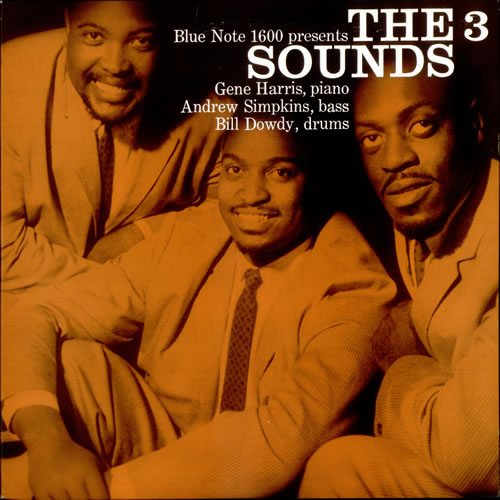
The Three Sounds
by Stephen Thomas ErlewineThe Three Sounds were one of the most popular artists on Blue Note Records during the late 50s and 60s, thanks to their nimble, swinging, blues-inflected mainstream jazz. Since their records sounded interchangeable and their warm, friendly jazz was instantly accessible, many critics dismissed the group at the time as lounge-jazz, but in the 90s, critical consensus agreed that the groups leader, pianist Gene Harris, was an accomplished, unique stylist whose very ease of playing disguised his technical skill. Similarly, his colleagues, bassist Andrew Simpkins and drummer Bill Dowdy, were a deft, capable rhythm section that kept the group in an appealing, bluesy groove. That groove was so appealing that the Three Sounds maintained a large fan following into the late 60s. During the groups prime period — from their 1958 debut for Blue Note to the departure of Dowdy in 1967 — the Three Sounds cut an enormous number of records. Many records hit the shelves, while others stayed in the vaults, to be issued at a later date. Throughout it all, the trios sound remained essentially the same, with no real dip in quality until the group began to splinter in the late 60s.Gene Harris was at the center of the Three Sounds throughout its entire existence. A native of Benton Harbor, Michigan, he began playing piano as a child, performing in public at the age of six. He soon became distracted by boxing and sports, but he continued to perform music, occasionally in a trio with drummer Bill Dowdy. After they graduated from high school in 1951, both Harris and Dowdy joined the Army and were assigned to different units. However, both men were discharged in 1954, and after they left the Army, they began pursuing different musical careers. Harris played with a variety of bands throughout the South and Midwest, while Dowdy moved to Chicago and played with a number of blues and jazz bands. Two years later, both musicians happened to settle in South Bend, Indiana and decided to form a band called the Four Sounds with bassist Andrew Simpkins and a tenor saxophonist. After running through a number of tenor saxophonists unsuccessfully, the three musicians decided to jettison the horn from their group and become the Three Sounds. For the next two years, the group played regularly at Midwest venues, particularly in Ohio. They played as a trio, and they also supported such soloists as Lester Young and Sonny Stitt. During this time, Horace Silver became a fan of the group and recommended them to Alfred Lion, the head of Blue Note. Despite the good word, the group remained unsigned. They toured with Stitt and relocated to Washington, D.C., where they worked as a trio and as a rhythm section for touring soloists; during this time, they played with such musicians as Miles Davis and Kenny Burrell. In the fall of 1958, they moved to New York to work with Stitt. Shortly after the moved to the city, the signed to Blue Note, in addition to supporting Nat Adderley on a Riverside session.The Three Sounds cut their first album for Blue Note in September of 1958. That record, Introducing the Three Sounds, became an unexpected success among record buyers, and the groups live performances earned fans like Horace Silver, Sonny Stitt, Miles Davis and Cannonball Adderley, even if critics tended to dismiss the group. In particular, a Down Beat reviewer panned the album, but that didnt stop the public from buying the record, which soon became one of the most popular jazz records of its years. Blue Note had the band re-enter the studio in February of 1959 to cut their second album, Bottoms Up. It was the third of a total of 17 sessions at Rudy Van Gelders studio (Introducing had taken two sessions to complete). At one point, Harris estimated that the group has released 35 albums worth of material, with many left in the vaults. During their first stint at Blue Note, they released the following, in addition to Introducing and Bottoms Up: Good Deal, Feelin Good, Moods, Here We Come, It Just Got to Be, Hey There!, Out of This World, and Black Orchid. The Three Sounds also supported such Blue Note artists as Stanley Turrentine and Lou Donaldson on several recording dates. The Three Sounds continued successfully on Blue Note until 1962, when they switched labels shortly after recording Black Orchid. They cut one album, Blue Genes, for Verve, then moved to Mercury, where they made three records between December 1962 and 1964. Later in 1964, the trio signed to Limelight, where they made three records. In October of 1966, the group returned to Blue Note and recorded Vibrations. Shortly after the sessions, drummer Bill Dowdy left the group and was replaced by Donald Bailey, who made his first recorded appearance with the group on 1967s Live at the Lighthouse. That album was followed in 1968 by Coldwater Flat, an album that found the trio augmenting their sound with a string section. By the time the group returned to the studio in September 1968 to cut Elegant Soul, Bailey was replaced by Carl Burnette. Elegant Soul continued the pattern of smooth, string-heavy productions, as did 1969s Soul Symphony. By the time the group made Soul Symphony, bassist Andrew Simpkins had left the trio and was replaced by Henry Franklin. Soul Symphony, for most intents and purposes, was the last record the Three Sounds made. They continued to perform live, and one of those concerts is documented on Live at the It Club, a 1970 date which was released in 1995. Later in 1970, Monk Montgomery replaced Franklin, but this version of the Three Sounds never recorded. Instead, Harris embarked on a solo career in 1971, releasing Gene Harris & the Three Sounds, which also featured Burnette and electric bassist Luther Hughes, along with a number of session men. From that point on, Harris concentrated on his solo career, recording for Blue Note over the next six years. Once his contract expired, Harris retired to Boise, Idaho, where he worked as a musical director at a hotel. Eventually, he returned to music after bassist Ray Brown convinced the pianist to play on an album for Pablo. Harris resumed his solo career in 1985, signing with Concord Jazz. His new albums, combined with CD reissues of classic Three Sounds dates, prompted a positive critical re-evluation of his music, and he maintained a strong reputation into the late 90s.
歌手单曲
本页 68 首- 1 The Three Sounds - Why Am I Treated So Bad (Live)
- 2 The Three Sounds - Here's That Rainy Day (Live)
- 3 The Three Sounds - Drown In My Own Tears (Live)
- 4 The Three Sounds - After Hours
- 5 Stanley Turrentine&The Three Sounds - Gee Baby, Ain't I Good To You(Alternate Take) (2000 Digital Remaster)
- 6 Gene Harris&The Three Sounds - Fever
- 7 Stanley Turrentine&The Three Sounds - Willow Weep For Me
- 8 The Three Sounds - Sittin' Duck (Single Version) (Digitally Remastered)
- 9 Gene Harris&The Three Sounds - Your Love Is Too Much
- 10 Gene Harris&The Three Sounds - Sugar Hill
- 11 Gene Harris&The Three Sounds - Do It Right Now
- 12 Stanley Turrentine&The Three Sounds - I Want A Little Girl (2000 Digital Remaster)
- 13 The Three Sounds - It's Nice (Remastered 2015)
- 14 The Three Sounds - Would'n You(Remastered 2015) (Remaster)
- 15 The Three Sounds - O Sole Mio (Remastered 2015)
- 16 The Three Sounds - Don't Go, Don't Go
- 17 The Three Sounds - Oh Well, Oh Well
- 18 The Three Sounds - On Green Dolphin Street
- 19 The Three Sounds - Climb Ev'ry Mountain
- 20 The Three Sounds - Once In A Lifetiime
- 21 The Three Sounds - What Kind Of Fool Am I
- 22 The Three Sounds - Jinne Lou
- 23 The Three Sounds - Time After Time
- 24 The Three Sounds - Falling In Love With Love
- 25 The Three Sounds - Angel Eyes
- 26 The Three Sounds - Nothing Ever Changes My Love For You
- 27 The Three Sounds - Besame Mucho
- 28 The Three Sounds - Love Walked In
- 29 The Three Sounds - I Could Write A Book
- 30 The Three Sounds - You Don't Tell Me
- 31 The Three Sounds - Gonna Build A Mountain
- 32 The Three Sounds - I Believe In You
- 33 The Three Sounds - As Long As He Needs Me
- 34 The Three Sounds - Yeh Yeh
- 35 The Three Sounds - Don't Get Around Much Anymore
- 36 The Three Sounds - Wouldn't You
- 37 The Three Sounds - Bobby
- 38 The Three Sounds - Goin' Home (Take 2)
- 39 The Three Sounds - Both Sides
- 40 The Three Sounds - Soft Touch
- 41 The Three Sounds - It Might As Well Be Spring
- 42 The Three Sounds - Tracy's Blues
- 43 The Three Sounds - That's All
- 44 The Three Sounds - Soft Winds
- 45 The Three Sounds&Stanley Turrentine&Copyright Control&Ronell - Willow Weep for Me (Remastered)
- 46 The Three Sounds - Out of This World (Remastered 2015)
- 47 The Three Sounds - Just in Time (Remastered 2015)
- 48 The Three Sounds - Girl of My Dreams (Remastered 2015)
- 49 The Three Sounds - My Silent Love (Remastered 2015)
- 50 The Three Sounds&Traditional&Copyright Control - It Might As Well Be Spring (Remastered)
- 51 The Three Sounds - Don't Get Around Much Anymore (Remastered 2015)
- 52 The Three Sounds - Willow Weep for Me (Remastered 2015)
- 53 The Three Sounds&Traditional&Copyright Control - O Sole Mio (Remastered)
- 54 The Three Sounds - Sister Caroline (Remastered 2015)
- 55 The Three Sounds - Besame Mucho (Remastered 2015)
- 56 The Three Sounds - Warm Blue Stream (Remastered 2015)
- 57 The Three Sounds - Time After Time (Remastered 2015)
- 58 The Three Sounds - Jinne Lou (Remastered 2015)
- 59 Gene Harris&The Three Sounds - Sittin' Duck
- 60 Gene Harris&The Three Sounds - (Sock It To Me) Harper Valley P.T.A.
- 61 Stanley Turrentine&The Three Sounds - Blue Riff
- 62 Stanley Turrentine&The Three Sounds - Gee Baby, Ain't I Good To You
- 63 Stanley Turrentine&The Three Sounds - Since I Fell For You
- 64 Stanley Turrentine&The Three Sounds - I Want A Little Girl
- 65 The Three Sounds - Summertime
- 66 The Three Sounds - I've Got Plenty Of Nothin'
- 67 Gene Harris&The Three Sounds - African Sweets
- 68 Stanley Turrentine&The Three Sounds - I Want A Little Girl (24 Bit / Remastered / 2000)